
Sortie Dogs
Bounded agent harness and validated orchestration loop plugin for OpenCode
1
12,380
近 7 天 1.5k
47.6
生态多维模型
3 天前
2026-10-17
快速安装与配置
opencode.json写入当前项目的 opencode.json,只对这个仓库生效。
opencode.json
{
  "$schema": "https://opencode.ai/config.json",
  "plugin": ["sortie-dogs@0.14.5"]
}
写入 ~/.config/opencode/opencode.json,对所有项目生效。
~/.config/opencode/opencode.json
{
  "$schema": "https://opencode.ai/config.json",
  "plugin": ["sortie-dogs@0.14.5"]
}
若你要在本地改造这个插件,先装到项目里再从本地路径引用。
shell
pnpm add -D sortie-dogsOpenCode 启动时会通过内嵌运行时自动加载 npm 依赖并缓存至本地目录,无需手动在全局环境执行安装。

An adaptive execution harness for OpenCode and Codex: preserve the goal, implement, validate, review, and deliver without taking over your setup.
Use your host normally. Invoke Sortie when a task needs coordinated execution and an evidence-backed result, not more agents for their own sake.








Current release: v0.14.5 · Release notes · Execution vision
Quick start · Workflow · Models · Measured results · Configuration · Documentation
Beta: the package is still stabilizing before 1.0. Both host integrations are implemented; Codex Missions have completed implementation, validation, correction and acceptance. Host-specific execution boundaries remain explicit.
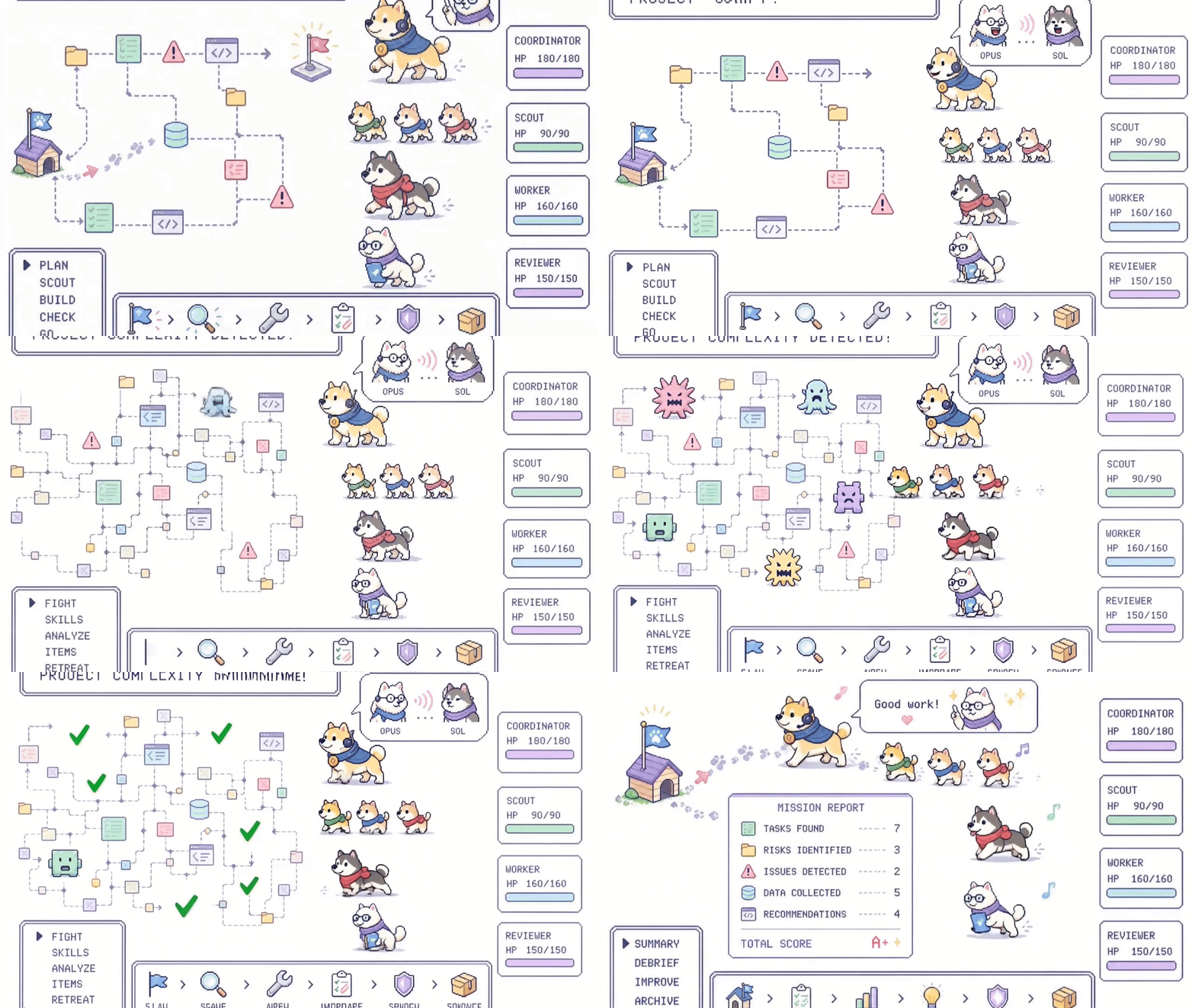
Why Sortie
- Autonomy: retain the original request across delegation, correction, compaction and restart. Finish in-request work through the existing host authority instead of routine approval round trips.
- Efficiency: Operator recommends an initial author from the instruction and known context. Coordinator can implement substantial work directly or delegate remaining work as execution makes that useful. Continue the same unit with its edits, valid evidence and cumulative budget.
- Visibility: show real commands, exits, timing, model routes, review disposition and final acceptance. Unknown execution or cost stays unknown, not an invented success or zero.
- Quality: meaningful formal checks and risk-based review establish completion, not model prose. Worker instructions carry a concise goal, explicit constraints and completion criteria; the harness owns bookkeeping. Instruction design.
- Coexistence: explicit invocation, existing authentication and host settings, one shared Mission lifecycle. Normal OpenCode/Codex use and user-owned files remain yours.
Quick start
Choose one host route. Both require Node.js 22.6+ and npm; project-local installation is recommended. OpenCode is not required for Codex, and Codex is not required for OpenCode.
Codex
Use an existing Codex CLI signed in with ChatGPT. On Windows, PowerShell 7 must already be available; POSIX uses bash. Sortie does not install Codex, start login or use a metered API fallback.
npm install --save-dev sortie-dogs@0.14.5
npx --no-install sortie-dogs codex init .
Restart Codex or open the project in a new chat, then invoke the installed skill explicitly:
$sortie-dogs Implement and verify the requested change
Or run the same natural-language Mission from the terminal:
npx --no-install sortie-dogs codex mission --prompt "Implement and review the requested change"
codex init installs .agents/skills/sortie-dogs only; it does not edit .opencode.
Do not run sortie-dogs init for this route. $sortie-dogs is Skills syntax, not an exact
/sortie-dogs slash command. Leave model overrides unset to retain the role defaults.
Existing native permissions remain authoritative. An SDK application can connect its already authorized parent-host executor; the CLI does not supply one or an interactive native approval bridge. Codex guide: SDK, permissions, progress, resume and manifest route.
OpenCode
Use OpenCode V2. In the target project:
npm install --save-dev sortie-dogs@0.14.5
npx --no-install sortie-dogs init .
Completely restart OpenCode, then run:
/sortie-v010 Implement and verify the requested change
Selecting dog-operator starts the same workflow. init registers the V2 plugin, installs Mission
assets and sets subagent depth to at least two while preserving unrelated settings. Existing
sortie-dogs/server bridges are reused. Internal dogs-coordinator / *-v010 roles are not entrypoints.
The v010 command, profile and configuration names remain for compatibility; they do not mean
v0.10 is installed. OpenCode setup and configuration ·
日本語 · 简体中文.
Mission workflow
Known unit: User → Operator → Worker → Validation → Review / Correction → Acceptance
Direct:     User → Operator → Coordinator → Validation → Review / Correction → Acceptance
Handoff:    Coordinator → Worker (same unit, retained edits/context/checks/budget)
- Operator saves original requirements, recommends an initial executor from already-known context, and owns user decisions and final acceptance. No routing-only investigation is required.
- Worker investigates, implements, runs meaningful checks and performs requested Git delivery in the same useful unit. A known unit/check can go directly to Worker without a planning handoff.
- Coordinator starts useful work, implements and validates directly when efficient, and delegates remaining work when useful. The Operator recommendation is advisory, not an execution lock.
- Review is initially independent for high-risk changes; low-risk skips are explicit. Findings can be corrected and validated by the same Reviewer, followed by recorded author self-recheck. That is not a second independent PASS.
- Acceptance compares the original request with actual source, checks and review evidence. Only the succeeded receipt authorizes DONE and the measured return report.
The default Mission profile is serial. Background responsiveness and status observations do not add parallel writers, replay unknown commands or imply completion. More agents are not the goal.
Whole-request workload appears as 全体作業量 n/100(概算), using ordinary plans and native
work observations, not budget consumption or fixed stage shares. Calculation adds no model
request or verification; formal acceptance still owns 100/100.
Workload estimates, optional weights and runtime cost.
For run-once / result-collection requests, a terminal failure can be the requested result:
validate and report it without an unauthorized repair/rerun loop. Acceptance preserves the real
operation exit and execution-failed outcome; it never turns a failed benchmark into a successful
one. Required success checks, missing commands and active/unstarted operations still block completion.
Mission tools and validation policy · Operation efficiency · Review policy
Default models
- Operator / Coordinator / Reviewer / Advisor: GPT-6.1 Sol,
xhigh. - Worker / Scout: Luna Fast,
max. - OpenCode:
openai/gpt-6.1-sol#xhighandopenai/gpt-6-luna-fast#max. - Codex: native
gpt-6.1-sol/xhigh; the Luna-fast alias maps to nativegpt-6-luna/maxwith separateserviceTier: "priority"(Fast).
Explicit host model selections remain authoritative. OpenCode routing and Codex native settings are separate; unsupported native models fail rather than silently changing route. Codex Fast uses subscription limits faster than Standard. Subscription USD cost and remaining allowance are not inferred from token totals.
Measured results
Codex end-to-end completion
Codex integration has completed real Missions on Ubuntu and Windows. The Windows large-write Anko trial reached final Operator acceptance after Worker validation and same-Reviewer correction:
- SDK exit 0,
accepted: true, Mission completed. - 190/190 terminal command receipts; no unresolved command. Large generated-parser writes completed.
- Separate local replay of official tests: reward 1, F2P 9/9, P2P 94/94.
- Elapsed 30m08.739s, including cleanup; ChatGPT subscription monetary cost unavailable.
The run used native Codex models/threads with an explicitly authorized SDK parent-host executor. It does not claim native Windows sandbox repair, Docker-equivalent scoring or a hosted leaderboard submission. Its fixed development package preceded v0.13.11, which includes the changes; the published release was not rerun or assigned that score. These are completion observations, not a general speed or success-rate guarantee.
Windows run and scoring · Windows models/shell evidence · Ubuntu acceptance
SWE-bench evaluation
v0.14.0 dev23 (2026-10-15 UTC)
Official resolution: 10/23 (43.48%); Mission completion: 22/23. One pass through the normal OpenCode CLI + Sortie Mission path, using the fixed released v0.14.0 package.
- All 23 frozen patches were officially scored: 10 resolved, 13 unresolved, zero empty patches,
evaluation errors or infrastructure failures. The cost-stopped
sqlfluff__sqlfluff-2419patch resolved officially, but its Mission remains incomplete; official correctness does not imply acceptance. - Pinned public Lite dev rows; one inference attempt per task, no retries. Official grading:
split=dev,max_workers=1,retry_count=0. Inference concurrency was 1 due to low host memory. - Actual Operator/Coordinator/Reviewer model:
openai/gpt-6.1-sol#xhigh; Worker:openai/gpt-6-luna-fast#max. Ten cases used Workers; 13 used Coordinator direct execution. - Inference wall time 2h53m28s; separate official grading 7m19s.
- Known estimated inference cost $16.76, with one pending usage record. Separate holds: $2 for unresolved usage and $5 for implementation/supervision; these are not known expenses. Costs are API-equivalent estimates, not invoices; the $2/task monitor is not an exact billing cap.
- Release/runner commit
e69a3b2317a76eeea1229034f52902812ff1d580; package SHA-256120922c31dd6d85040210d68456192b4e6aa45dc87a11451476f3ed576a68e30.
Local evidence (generated artifacts are not committed):
_testenv/autodev/sortie-dogs-dev23/benchmark-v0140-20261015/one-pass-summary.json.
Historical v0.12.24 test300
SWE-bench Lite test300: 170/300 (56.67%), fixed v0.12.24, one pass@1 campaign. Nine empty patches, zero official evaluation errors, frozen predictions and trajectories for all 300 instances. Workers ran Luna Fast/max; management/review ran GPT-6 Sol/xhigh. This is a system result, not a Luna-only comparison or Verified/full SWE-bench score.
Confirmed inference expense $162.99; separate unknown-pricing budget hold $34.60 is not known expense. Official local evaluation and leaderboard acceptance are separate.
Technical report · Public predictions/logs/trajectories · Result history and conditions
v0.13.1 dev23 (2026-09-30)
8/23 (34.8%), versus v0.12.25's 7/23; all seven prior resolutions retained, no empty patches or official evaluation errors. Fixed conditions, stopped-run accounting and costs.
Each score belongs to its fixed candidate. SWE-bench remains an optional measurement, not a release gate. Different splits, budgets, models and conditions are not controlled comparisons or proof of a fix's effect.
Configuration
OpenCode: project settings .opencode/sortie-dogs-v010.json, global settings
~/.config/opencode/sortie-dogs-v010.json, JSON override SORTIE_DOGS_V010_CONFIG.
The default Mission state is .sortie-dogs-v010/; generated controls are host-owned.
Precedence, settings, global installation and stable compatibility.
Codex: use codex mission --help or CodexMissionSession. Optional --model, --effort,
--permissions, --trusted-pwsh and --resume are explicit host choices, not OpenCode settings.
SDK and recovery reference.
Updates and removal
Install the desired package version and rerun your host's initializer:
- Codex:
npx --no-install sortie-dogs codex init ., then restart/open a new Codex chat. - OpenCode:
npx --no-install sortie-dogs init ., then completely restart OpenCode.
An OpenCode config-local bridge may resolve a separate package; npm-global update alone does not
update it. Global/update instructions.
The current Mission asset marker is 0.14.5-unborn-proof-v1; the unchanged Codex skill marker is
0.13.11-codex-skill-v2. Installed markers alone do not prove a running host reloaded the new version.
There is no supported uninstall command. Remove the dependency and only known Sortie-owned paths;
follow the manual removal guide, never delete the entire .opencode directory.
Documentation
- Usage: Codex guide · OpenCode configuration · 日本語 OpenCodeガイド · 简体中文 OpenCode指南.
- Design: Worker instructions · Quality-first review · Operation efficiency.
- Evidence: Codex completion · SWE-bench history · Historical local case study.
- Development: Testing · CLI testing · Windows tests · Release routine.
- Releases: v0.14.5 · v0.14.4 · v0.14.3 · v0.14.2 · v0.14.1 · v0.14.0 · v0.13.22 · v0.13.21 · v0.13.20 · v0.13.19 · v0.13.18 · v0.13.17 · v0.13.16 · v0.13.15 · v0.13.14 · v0.13.13 · v0.13.12 · v0.13.11 · v0.13.10 · v0.13.9 · All GitHub releases.
Community
Contributing · Code of conduct · Security policy / private reports · Accessibility · Report a bug or propose a feature.
Licensed under MIT.
同类生态推荐

Dynamic Workflows
@malhashemi/opencode-dynamic-workflows
Deterministic multi-agent Workflows for OpenCode: TypeScript scripts that fan work out to subagents, with typed results, a live TUI panel, a web app and a versioned protocol.

Herdr
opencode-herdr
Route OpenCode agents through Herdr panes as herdr/<adapter>/<model> (Cursor, Claude, Codex, OpenCode)

Workflows
@rphang/opencode-workflows
Claude Code-style dynamic workflows for opencode v2: the model writes a JS orchestration script that fans work out to parallel subagents (agent, parallel, pipeline, budget, resume)