
opencode-buddyA virtual ASCII pet companion that lives in the opencode TUI sidebar. Hatches, feeds, plays, and reacts to what you're coding.
4
166
近 7 天 32
36.0
生态多维模型
2 个月前
2026-06-15
快速安装与配置
opencode.json写入当前项目的 opencode.json,只对这个仓库生效。
opencode.json
{
  "$schema": "https://opencode.ai/config.json",
  "plugin": ["opencode-buddy@0.6.2"]
}
写入 ~/.config/opencode/opencode.json,对所有项目生效。
~/.config/opencode/opencode.json
{
  "$schema": "https://opencode.ai/config.json",
  "plugin": ["opencode-buddy@0.6.2"]
}
若你要在本地改造这个插件,先装到项目里再从本地路径引用。
shell
pnpm add -D opencode-buddyopencode 启动时会通过内嵌运行时自动加载 npm 依赖并缓存至本地目录,无需手动在全局环境执行安装。
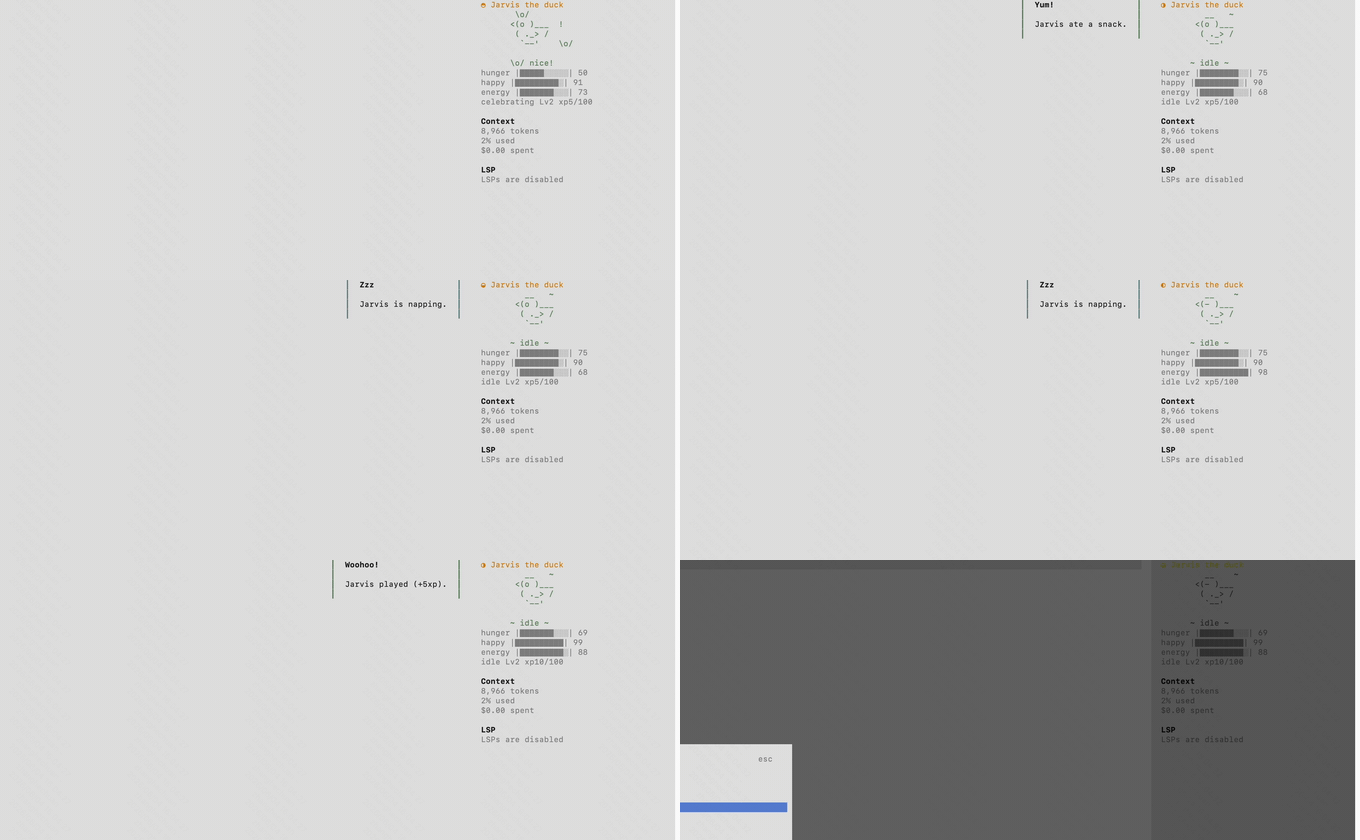
A virtual ASCII pet companion that lives in the opencode TUI sidebar. One buddy per opencode session — switch sessions and you meet a different buddy; reopen the same session later and yours is exactly as you left it. Hatches, grows, and earns xp from your actual coding — every tool call, every completed turn, every approved permission feeds the buddy.
┌──────────────────────────┐
│  opencode TUI            │
│                          │
│  > your prompt here      │
│                          │
│         sidebar          │
│ ┌──────────────────────┐ │
│ │ Quack the duck       │ │
│ │       __             │ │
│ │     <(o )___         │ │
│ │      ( ._> /         │ │
│ │       `--'           │ │
│ │ ──────────────────── │ │
│ │ hunger ████████░░ 79 │ │
│ │ happy  ████████░░ 79 │ │
│ │ energy ██████████ 100│ │
│ │ idle · Lv 1 · xp 0   │ │
│ └──────────────────────┘ │
└──────────────────────────┘
Since v0.5.0 the buddy is work-driven: xp comes from the LLM calling tools, finishing turns, and you approving permissions — not from slash commands. Slash commands stay around for "I want to feed my pet right now" interactions. The buddy gets tired when you push it hard, naps to recover when you walk away, and slows down late at night.
Since v0.6.0 the buddy is per-session: each opencode session has its own state file at ~/.config/opencode-buddy/sessions/<sessionID>.json, so multiple windows and projects never share or fight over a buddy. Sessions idle for 30+ days are automatically deleted by a daily LRU sweep.
Install
Requires opencode ≥ 1.15.
npm install -g opencode-buddy
The postinstall script automatically registers the plugin in both config files using the same spec. opencode picks the right entrypoint from the package's exports field based on runtime kind:
opencode.json(kind:server) →src/server-plugin.jsviamain(no-op since 0.3.x)tui.json(kind:tui) →src/tui-plugin.jsxviaexports["./tui"]
Both ~/.config/opencode/opencode.json and ~/.config/opencode/tui.json get the same plugin: ["opencode-buddy"] entry. The postinstall is JSONC-safe — it leaves any file that contains comments alone and asks you to add the entry manually:
// ~/.config/opencode/opencode.json
{
  "plugin": ["opencode-buddy"]
}
// ~/.config/opencode/tui.json
{
  "$schema": "https://opencode.ai/tui.json",
  "plugin": ["opencode-buddy"]
}
Restart opencode. The buddy appears in the sidebar.
Usage
Slash commands
Type / in the prompt to see the slash commands. The buddy ships with seven:
| Slash command | Effect |
|---|---|
/buddy |
Show the current session buddy's stats as a toast |
/buddy-feed |
Feed the buddy (+25 hunger, -5 energy) |
/buddy-play |
Play with the buddy (+15 happiness, +1 xp, -10 energy, -5 hunger) |
/buddy-rest |
Let the buddy rest (+30 energy) |
/buddy-list |
List every active session's buddy (name, species, level) |
/buddy-rename |
Open a prompt to rename the buddy (max 20 chars) |
/buddy-switch |
Open a picker to switch to duck, cat, dragon, axolotl, robot, or ghost |
/buddy-play only gives +1 xp — meaningful xp comes from coding (see below). All slash commands except /buddy-list target the current opencode session's buddy (read from api.route.current.params.sessionID).
Automatic reactions (work-driven xp & rewards)
The buddy listens to opencode's live session events. Every event tweaks the buddy's stats so the sidebar actually drifts in response to what you're doing:
| Trigger | Effect |
|---|---|
| Prompt submitted | enter working state, mark lastPromptAt |
| Tool call succeeds | +xp per tool (read=1, edit/write/bash=3, others=2), +0.2 happy |
| 3 consecutive tool successes (no failure) | +5 xp streak bonus |
| Same tool used >5 times in one turn | xp halved for that tool (anti-grind) |
| Tool call fails | -1 happy, -0.5 energy, streak reset; 2+ fails → scared |
| Todo marked completed | +5 xp per item |
File edited (file.edited) |
+1 hunger (30s global throttle) |
| Shell command finished | +1 hunger, +1 energy |
| Permission granted (once/always) | +3 hunger, +1 happy |
| Git branch switched | +3 hunger, +1 happy |
| Session history compacted | +10 energy, +2 happy |
| Idle >5 min without a prompt | +5 energy (5 min cooldown) |
Turn finished (session.idle) |
+10 base xp + accumulated (cap 30/turn), 3s celebrating, toast Turn complete +N xp or Level up! |
| Session error | 5s scared |
| Level up | +5 hunger, +3 energy, +3 happy |
Passive metabolism
Between events the buddy slowly drifts on a natural clock:
| Stat | Per minute | Notes |
|---|---|---|
| hunger | -0.3 | always |
| happiness | -0.2 | always |
| energy | -0.15 (×1.5 at 23:00–05:00) | drains 1.5× faster late at night |
| energy (sleeping) | +1.0 | the buddy heals itself if you walk away |
Hard thresholds:
- Energy < 20 →
sleeping(animation pauses; energy recovers passively) - Hunger < 25 →
scaredfor 30 s
State lives in ~/.config/opencode-buddy/sessions/<sessionID>.json — one file per opencode session. Switch sessions in opencode and the sidebar swaps to the corresponding buddy. Reopen the same session later and the buddy is exactly as you left it.
Per-session storage
~/.config/opencode-buddy/
└── sessions/                      # active buddies
    ├── __default__.json           # fallback for LLM tool calls with no session arg
    ├── abc-123.json               # session "abc-123"
    └── def-456.json               # session "def-456"
- One file per opencode session.
1000 active sessions ≈ 500 KB. __default__is a synthetic session used when no real opencode session is in scope (e.g. the LLM tool without asessionargument). Upgrades from v0.4/v0.5 transparently migrate the legacy globalstate.jsonintosessions/__default__.jsonon first read.- A background timer runs at plugin boot and once a day, deleting any session file whose
idleAtis older than 14 days. The buddy is gone for good — no archive folder to clean up later. /buddy-listshows the active roster; the current session's buddy is marked with→.
What you see in the sidebar
The sidebar shows the buddy's species-specific ASCII art, plus four lines under it:
[BDDY]  Quack the cat        <- species + name (preceded by a rotating status dot)
<art rows>                     <- 6 rows of the species art
hunger |████░░░░░░| 79         <- hunger bar
happy  |███░░░░░░░| 60         <- happiness bar
energy |███████░░░| 70         <- energy bar
idle  Lv1  xp5/50              <- state label + level + xp progress (xp needed = level * 50)
The bottom state label reflects the persisted state field in the session's file. It changes on session events (celebrating / scared / working) and on energy/hunger thresholds (auto sleeping or scared). The art's idle state has 3 frames; the sidebar re-renders the current frame each time the plugin-level frame signal advances.
Six species
        duck                    cat                  dragon
          __                /\_/\                  /^^\
        <(o )___          ( o.o )                (o o)  ~~
         ( ._> /           > ^ <                  >w<    ~
          `--'            /|   |\                /| |\
       ~ idle ~         (_|   |_)               (_| |_)
                           meow                   rawr

      axolotl                robot                  ghost
       ^___^              [ O . O ]              .-"-"-.
      (o . o)             /|#####|\              ( o . o )
     \|_|_|/             / |#####| \             | ~  ~ |
      \| |/               |     |                |     |
       ) (               /| | | |\               \uuuuu/
     ~ ambien              beep                   boo
Each species has a per-character color palette. The idle state has 3 frames; frameCount is exposed so the View can pick a frame to render. The buddy renders whatever frame frame() % fc() returns at the moment of re-render.
Architecture
flowchart LR
    subgraph User
        U[Opencode TUI user]
    end

    subgraph OpencodeTUI["opencode TUI process (binary)"]
        direction TB
        Config[("tui.json<br/>plugin: [opencode-buddy]")]
        Runtime[TuiPluginRuntime]
        Sidebar[Sidebar component]
        Prompt[Prompt component]
        Slots{{"slot registry<br/>sidebar_content"}}
        Keymap{{"keymap<br/>(slash commands)"}}
        Bus{{"event bus<br/>(session/tool/file/<br/>perm/todo/vcs/...)"}}

        Config --> Runtime
        Runtime --> Slots
        Runtime --> Keymap
        Slots --> Sidebar
        Keymap --> Prompt
    end

    subgraph Buddy["opencode-buddy plugin (jsx)"]
        direction TB
        TUIEntry["tui entry<br/>(id: opencode-buddy)"]
        View[View component<br/>SolidJS]
        FrameSignal[("frame signal<br/>(plugin-level)")]
        AnimTick[setInterval 300ms<br/>frame++ gated by energy]
        RefreshTick[setInterval 1500ms<br/>mtime poll]
        IdleTimer[setInterval 60s<br/>idle-recovery]
        Hooks["event hooks (10+)<br/>prompted / tool.called /<br/>tool.success / tool.failed /<br/>todo / file.edited / perm /<br/>shell / branch / compacted /<br/>idle / error"]
        TurnAccum[("turnAccum<br/>per-session memory<br/>xp · tools · failures ·<br/>streak · toolCounts")]
        SlashCmds["slash commands<br/>feed / play / rest /<br/>status / rename / switch"]

        TUIEntry --> FrameSignal
        TUIEntry --> View
        TUIEntry --> SlashCmds
        TUIEntry --> Hooks
        TUIEntry --> IdleTimer
        FrameSignal --> AnimTick
        View --> RefreshTick
        Hooks <--> TurnAccum
    end

    subgraph State["Persistent state (per session)"]
        direction TB
        StateRoot["~/.config/<br/>opencode-buddy/"]
        SessionsDir["sessions/"]
        Default[("__default__.json")]
        Sess1[("abc-123.json")]
        Sess2[("def-456.json")]

        StateRoot --> SessionsDir
        SessionsDir --> Default
        SessionsDir --> Sess1
        SessionsDir --> Sess2
    end

    U -->|types| Prompt
    Prompt -->|/buddy-feed etc| Keymap
    Keymap --> SlashCmds
    SlashCmds -->|"read+write per session"| SessionsDir
    SlashCmds -->|toast feedback| U

    Slots -->|invokes renderer| View
    View -->|render frame| Sidebar
    View -->|"reads mtime per session"| SessionsDir
    RefreshTick -->|state changed| View
    Bus -->|10+ event types| Hooks
    Hooks -->|"mutate per session"| SessionsDir
    Hooks -->|Level up! / Turn complete toast| U
    IdleTimer -->|"+5 energy per session"| SessionsDir
    AnimTick -->|"reads energy per session"| SessionsDir

    classDef store fill:#1e293b,stroke:#64748b,color:#f1f5f9
    class Default,Sess1,Sess2,TurnAccum store
Boot flow
- opencode reads
~/.config/opencode/tui.jsonand discovers the buddy entry underplugin. - The TUI runtime loads
tui-plugin.jsxfromopencode-buddy(viaexports["./tui"]inpackage.json). - The
tui(api)function runs once. It sets up:- A plugin-level frame signal +
setInterval(300 ms) that ticks it. The View is passed the signal as a prop, so slot re-renders cannot freeze the animation. - The
sidebar_contentslot. The slot renderer is cached persessionIDso the View instance is reused across re-renders and survives session switching. - 7 slash commands on the keymap (including
/buddy-list). - 10+ event hooks on the session bus (prompted, tool.called/success/failed, todo, file.edited, permission.replied, shell.ended, vcs.branch.updated, session.compacted, session.idle, session.error). Each hook resolves the target
sessionIDfrom the event payload (orlastActiveSessionIDfor events that don't carry one) and mutates that session's file insessions/, updating the in-memoryturnAccumalong the way. - A 60-second idle-recovery timer that iterates all sessions in
sessions/and grants+5 energyto any whoselastPromptAtis older than 5 min. - A daily LRU sweep that deletes session files whose
idleAtis older than 14 days.
- A plugin-level frame signal +
- The TUI's
<Slot name="sidebar_content" />resolves to the buddy's cachedView(keyed bysession_id). The View reads the frame signal and re-renders the buddy art on every tick. - The View also runs a 1500 ms timer that polls its own session's file mtime. When the file changes (slash command or event hook wrote to it), the View reloads and re-renders.
- The animation timer advances unconditionally; per-session
sleepingbuddies just render the same static frame on every tick (cheap; therenderFrameis pure). - On
session.idle, the event hook settles the turn atomically for that session: load → applyonTurnDone(state, accumXp, stats)→ save. If a level-up happened, aLevel up!toast surfaces; otherwiseTurn complete +N xp from M tool calls.
Why two config files with the same spec?
opencode has separate plugin registries for the server (LLM tools, file watching) and the TUI (sidebar slots, slash commands, keybindings). When the same package spec appears in both, opencode looks at the package's exports field to pick the right entrypoint:
opencode.json→kind: "server"→ loadssrc/server-plugin.jsviamain(no-op since 0.3.x)tui.json→kind: "tui"→ loadssrc/tui-plugin.jsxviaexports["./tui"]
Slash commands and event hooks update state instantly without round-tripping through the LLM, which is the right UX for both "I want to feed my pet right now" interactions and "the LLM just finished a turn, react now" reactions.
Project layout
opencode-buddy/
├── package.json
├── README.md
├── LICENSE
├── scripts/
│   └── postinstall.mjs     # auto-registers plugin in opencode.json + tui.json
└── src/
    ├── tui-plugin.jsx     # TUI plugin: per-session slot + 7 slash commands + 10+ event hooks
    │                      #   + idle-recovery timer + daily LRU sweep
    ├── server-plugin.js   # Server plugin: LLM tool (accepts session arg) + action=list
    ├── species.js         # ASCII art + per-species palettes + 3-frame idle loop
    ├── state.js           # state machine: tick (night/sleep aware), feed, play, rest,
    │                      #   plus event-driven mutators (onPromptStart, onToolSuccess,
    │                      #   onToolFailure, onTurnDone, onTodoCompleted, onFileEdited,
    │                      #   onPermissionAllowed, onShellSuccess, onBranchUpdated,
    │                      #   onCompacted, onIdleRecovery, onStreak), maybeLevelUp
    └── persistence.js     # per-session load/save/mtime + sweep + listSessions + legacy migration
State lives at ~/.config/opencode-buddy/sessions/<sessionID>.json (one file per opencode session, plus a __default__ synthetic session for LLM tool calls outside a session). ~/.config resolves via os.homedir() so it works on Linux, macOS, and Windows.
Uninstall
npm uninstall -g opencode-buddy
Then remove "opencode-buddy" from opencode.json and from tui.json (the npm uninstall does not auto-edit user config).
License
MIT