
@geohar/opencode-cribsheetOpenCode plugin: run the crib (cribsheet) memory + code-index MCP server via sharedserver, register its endpoint, inject the reach-for-crib directive, and ship the /crib command. Stands down when a combiner already serves crib.
1
1,419
近 7 天 533
41.8
生态多维模型
16 小时前
2026-08-19
快速安装与配置
opencode.json写入当前项目的 opencode.json,只对这个仓库生效。
opencode.json
{
  "$schema": "https://opencode.ai/config.json",
  "plugin": ["@geohar/opencode-cribsheet@0.10.0"]
}
写入 ~/.config/opencode/opencode.json,对所有项目生效。
~/.config/opencode/opencode.json
{
  "$schema": "https://opencode.ai/config.json",
  "plugin": ["@geohar/opencode-cribsheet@0.10.0"]
}
若你要在本地改造这个插件,先装到项目里再从本地路径引用。
shell
pnpm add -D @geohar/opencode-cribsheetopencode 启动时会通过内嵌运行时自动加载 npm 依赖并缓存至本地目录,无需手动在全局环境执行安装。
cribsheet
persistent memory for your AI — plain markdown on disk, semantically indexed
Your AI assistant forgets everything between sessions. cribsheet gives it a durable, searchable memory — as plain markdown files you own, not a black box — that persists across sessions and is shared across every agent and tool you run.
It remembers three kinds of things:
- Notes — conventions, gotchas, hard-won facts. Written as markdown, found by meaning (semantic + keyword search), not just exact words.
- Code — a symbol index of your repos: every function/class/method with an LLM
"what it does" description, a real call graph (who calls what), and any durable
learnings you pin to a symbol. It answers the questions
grepcan't — find this by concept, what calls this, what does this do — across files. - Decisions and plans — settled design choices and work items as a graph, not prose: each records what it rests on, so an edit anywhere names what it just put out of date, and a plan outlives the session that wrote it.
Disk is the source of truth; the vector index is a derived, rebuildable cache. One
warm process serves your editor (over MCP) and your terminal (crib <noun> <verb>) alike.
crib= the command.cribsheet= the project. See DESIGN.md for the full architecture.
Why
- Agents forget. Memory should be durable and shared. A decision you made last
week, in another repo, in another tool's session, is one
lookupaway — because it's the same markdown tree behind every agent. grepcan't answer "what does this do" or "what calls this." The code index answers by intent and traces the real call graph, so an agent (or you) finds code by concept and understands its neighbourhood in one call.grepcan't tell you what a change invalidates, either. Design decisions and plan items carry dependency edges, so a decision knows what it rests on and what rests on it: change one and you're told, with the chain, which decisions just went stale — and finishing a plan item names what it just unblocked. Prose in a file can't make that promise; the graph can.- It's plain markdown you own. No proprietary store — edit notes in your own editor, diff them in git, sync them across machines. The index rebuilds itself.
- Built to actually get used. The hard part of memory isn't storing — it's recall at the right moment. cribsheet ships the delivery layer: a one-line directive that keeps the habit in context, plugins that wire it into Claude Code, and an always-warm daemon so a lookup is never the slow path.
Quickstart
1 — Install — cribsheet is on PyPI; uv (or pipx) puts crib on your PATH
with the heavy deps isolated:
uv pip install cribsheet # or: uv tool install cribsheet · pipx install cribsheet
That's the complete product — store, ONNX embedder (no torch), MCP server + warm
daemon, watcher, and generation (polyllmkit, pulled from PyPI). The one genuine
extra is [st], the torch embedder (host-specific wheels). No submodule dance —
vendor/llmkit is only for hacking on llmkit itself.
Dev install (editable venv / uv)
python -m venv .venv && . .venv/bin/activate
pip install -e .                        # deps (incl. polyllmkit) from PyPI

uv sync                                 # or: uv pip install -e .

# the torch embedder + llmkit's native LLM adapters (polyllmkit from PyPI):
pip install -e '.[st]' 'polyllmkit[md,bridge,anthropic,google,claude]'

# hacking on llmkit itself: overlay the submodule editable (uv sync restores git)
git submodule update --init && pip install -e ./vendor/llmkit
2 — Wire it into Claude Code. One plugin installs the MCP server, the /crib
command, and the "reach for memory" directive:
claude plugin marketplace add georgeharker/cribsheet
claude plugin install cribsheet
The plugin needs nothing installed by hand. It fetches
sharedserver (prebuilt — no Rust
toolchain) and crib itself on first use if they aren't already present; curl and
uv are the only prerequisites. sharedserver keeps
one warm crib serving every session, and it's the same process the CLI attaches to.
Anything you've installed yourself wins: a crib or sharedserver already on PATH
is used as-is, and $CRIB_BIN / $SHAREDSERVER_BIN are honoured without being
second-guessed. /crib goes through the same resolution as the backend, so the CLI and
the MCP server can never disagree about which crib they mean.
On OpenCode? The counterpart plugin lives in
plugins/opencode and does the same three
things (MCP server on :7732, /crib command, reach-for-crib directive). Add it to
your opencode.json:
{ "plugin": ["@geohar/opencode-cribsheet@latest"] }
Full options are in the plugin's README; the
MCP_COMBINER switch below applies to it too.
On Pi? Pi needs pi-mcp-adapter
(pi install npm:pi-mcp-adapter) plus the @geohar/pi-cribsheet extension in
plugins/pi, which does the same three things
(MCP server on :7732, /crib command, reach-for-crib directive). Point the adapter at
crib with a one-line mcp.json (plugins/pi/mcp.json.example)
and load the extension via ~/.pi/agent/extensions/ or settings.json. Full options
(PI_CRIBSHEET_*) are in the plugin's README;
the MCP_COMBINER switch below applies to it too (combiner-served → directive + /crib
only).
The plugin writes to your user-scope MCP config (claude mcp add|remove) rather
than declaring a server in its manifest — that is what lets one plugin serve both
deployments, and it means crib appears in claude mcp list as a user server you can
inspect or remove.
Already have crib served another way? If an aggregator such as
mcp-companion already proxies
crib's tools, a second registration would mount every tool twice. Set the switch
once, machine-wide, and the plugin registers nothing — you still get /crib and
the directive:
# ~/.zshenv — must be set before Claude Code starts
export MCP_COMBINER=1                    # a combiner serves my MCPs…
export MCP_COMBINER_SERVES_CRIBSHEET=0   # …except crib — per-backend override, wins
It's a global toggle, not per-session, and it converges both ways: setting it removes crib's registration, unsetting it restores it. A change lands in the next session. Details: docs/plugin-mcp-registration.md.
Prefer to wire it by hand? Copy CLAUDE.md.example into your
global $CLAUDE_CONFIG_DIR/CLAUDE.md — that one-line directive is what keeps the
habit in context (tool descriptions alone load too late to form it).
3 — Use it. The CLI verbs mirror the MCP tools, so anything Claude does you can do too:
# notes
crib note store "Chroma is refcounted by sharedserver." -p notes  # remember a fact
crib note lookup "how is chroma managed" -p notes                 # find it by meaning
crib note apropos "how is chroma managed" -p notes                # hits as full sections

# code — onboard a repo, then ask it questions grep can't answer
cd ~/Development/myrepo
crib project setup                                # index code + docs (one call)
crib code lookup "combine ranked lists"           # find a symbol by CONCEPT
crib code dossier LexicalCache.get                # everything about one symbol
crib code graph reciprocal_rank_fusion            # walk the call graph (pstree)
crib learning add reciprocal_rank_fusion \
     "fuses by RANK, not score — robust to scale differences"   # pin a learning to it

# decisions & plans — what was settled, and the work that rests on it
crib design add "Content-hash gating is the only write/watcher coordination" \
     "One idempotent, hash-gated index path under a per-path lock." \
     --dep "Disk is truth, Chroma is a rebuildable cache" -p cribsheet
crib design check -p cribsheet          # what a change put out of date, and why
crib plan add "Backfill section hashes for existing citations" -p cribsheet
crib plan next -p cribsheet             # "where was I" — this session or a later one
That's the loop: store what's worth keeping, look it up by meaning, onboard a repo
and explore it by concept, and settle a decision where the graph can tell you later
what depends on it. An agent that hits an unindexed repo self-diagnoses toward
project setup, runs it, and carries on.
The surface
Every command reads as crib <noun> <verb> (and the matching MCP tool
<noun>_<verb>) — seven nouns, each with its own verbs:
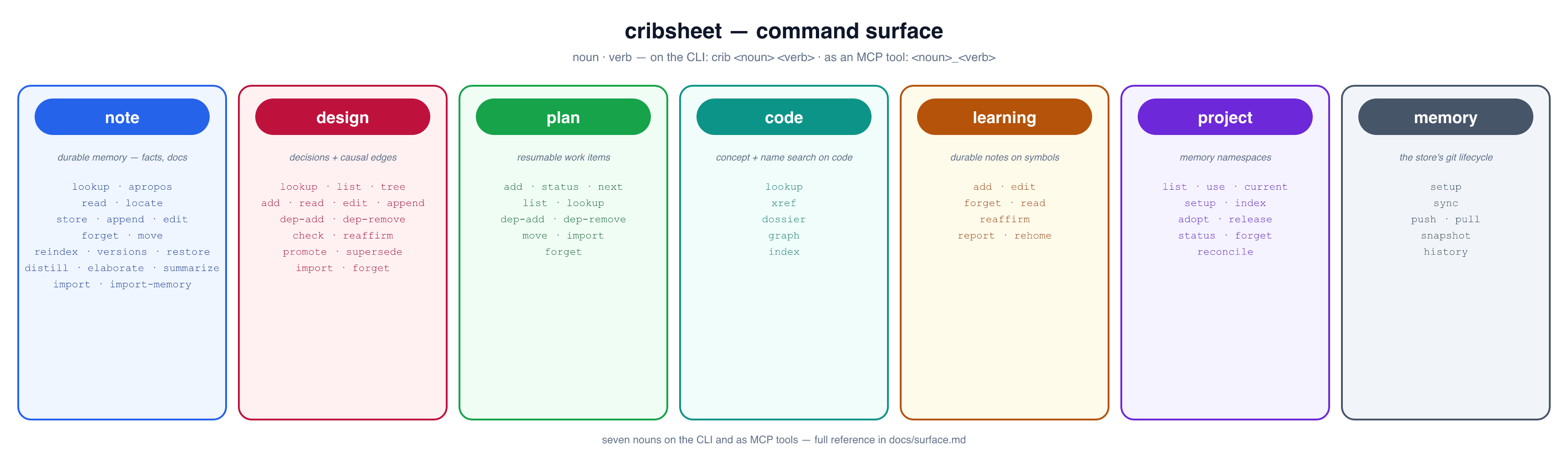
Every capability, its CLI form, its MCP tool, and a one-liner lives in docs/surface.md — the full reference. Grouped by task:
| notes | code | decisions & plans | |
|---|---|---|---|
| find | note lookup / note apropos (full sections) |
code lookup (concept ⊕ name), code dossier, code graph/xref |
design lookup/read/tree, plan list/next |
| write | note store, note append, note edit, note forget, note move |
learning add/edit/forget |
design add/edit/append (--dep), plan add/status |
| onboard | note import (files → memory), note import-memory |
project setup / index / status |
design import / plan import (extract from a doc) |
| housekeeping | note reindex, project reconcile, note versions, note restore, memory history |
learning report, learning rehome |
design check / reaffirm / promote / supersede |
Notes and code share one store, so lookup surfaces a repo's docs alongside your
stored knowledge. A repo's .crib file ties it to a project and declares which
source and docs to index (docs are indexed in-situ — the repo stays the master;
crib holds only the index).
Decisions and plan items live in their own pillar stores — sibling design/ and
plans/ dirs sharing the note-store machinery but never the note search — and the
facet verbs are the way in, because only they speak the dependency edges. Who owns
which bytes, and which verbs may write them, is docs/storage.md.
By default a verb attaches to the warm daemon (the same process the MCP server
runs), so it's fast; --no-daemon runs in-process, --json gives machine output.
Going further
- Run the MCP server — the plugin (Quickstart) is the easy path: it registers
crib and keeps it warm for you. To run it yourself instead:
crib --mcp(stdio) orcrib serve --http --port 7732, registered as asharedserver-backed HTTP MCP so one warm crib serves every client (and the same process the CLI attaches to). SetMCP_COMBINER=1(orMCP_COMBINER_SERVES_CRIBSHEET=1) when something else already serves crib — a combiner, or your own external process — and the plugin will stand down rather than register a second copy. - Share across machines — the data dir is a git repo; notes sync via plain git
with a frontmatter-aware merge driver so provenance never conflicts:
Full walkthrough: docs/resume-on-new-machine.md.crib memory sync --remote git@host:notes.git # first machine: create + push crib memory setup --remote git@host:notes.git # every other: init + merge driver + pull crib memory sync # thereafter: commit + pull + push - Mirror Claude's own memory —
crib note import-memory(MCP:note_import_memory, so an agent can do it too) mirrors Claude Code's harnessmemory/*.mdinto crib (host-namespaced) and live-syncs it, so it's searchable alongside everything else. - Configure —
$XDG_CONFIG_HOME/crib/config.tomlpicks the embedder, retrieval mode, daemon, and backends;crib infoprints the resolved paths. The defaults are sensible — a minimal override:
Language-server and generation-provider examples:[embed] model = "hash" # or "fe:BAAI/bge-small-en-v1.5" (fastembed), "st:<model>" [retrieve] hybrid = true # dense ⊕ BM25, RRF-fused; rerank = true adds a cross-encoder [chroma] mode = "embedded" # "embedded" | "shared" (sharedserver) | "json" [locations] DEV = "~/Development" # provenance paths stored as $DEV/… so they sync cleandocs/lsp.json.example,docs/generate.toml.example.
Authentication (optional)
When crib runs as an HTTP daemon (crib serve --http / behind a bridge) its
/mcp endpoint is unauthenticated by default — fine on loopback, but open the
moment you bind beyond 127.0.0.1, or on a shared machine. Set
CRIBSHEET_AUTH_TOKEN and every request to /mcp must present
Authorization: Bearer <token>; a missing/wrong token gets a plain 401 (no
WWW-Authenticate, so standards clients don't drift into OAuth). Unset ⇒ open
(unchanged); /health stays open.
The crib CLI presents the same token automatically when it's set, so nothing
changes for local use. When crib runs behind the
mcp-combiner, give the combiner
the token in crib's servers.json entry:
{"auth": {"bearer": "${CRIBSHEET_AUTH_TOKEN}"}}. (The gate is
crib/inbound_auth.py, vendored byte-identical from the combiner.)
How it works
The short version: every write funnels through one idempotent, content-hash-gated
index path under a per-path lock, so races degrade to redundant work, never a wrong
index. Retrieval fuses a dense vector ranking with a warm BM25 lexical ranking
(RRF), with an optional cross-encoder rerank. Embedder and store are both pluggable
(dependency-free defaults for dev). The code index is built live from language
servers (.lsp.json specs — ty/pyright, rust-analyzer, gopls, clangd, shuck, …) for
the structural facet and an LLM for the "what it does" descriptions.
The deep dives live in the docs — see Documentation below.
Documentation
Using cribsheet
- docs/guide.md — the user guide: the six facets, the noun-verb interface, and seven runnable workflows. Start here.
- docs/surface.md — the complete CLI ⇄ MCP reference: every noun, every verb, one line each.
- docs/storage.md — where each kind of content lives, who owns the bytes, and which verbs may write them.
- docs/resume-on-new-machine.md — share your memory across machines over plain git.
Under the hood
- DESIGN.md — the architecture and the why, end to end (with the hybrid-retrieval pipeline diagram).
- docs/implementation.md — how it works today: a subsystem-by-subsystem map anchored to files and symbols (with the collaborator-architecture and code-index diagrams). Start here to work on the code.
- docs/code-symbol-index.md — how the code↔note index is built, and the learnings model.
- docs/retrieval-and-adoption.md — retrieval quality, and why delivery (not capability) makes a memory tool get used.
- docs/knowledge-capture.md —
distill/elaborate/summarize, the generation layer over notes.
Status & tests
The store → index → lookup path, the version ring, the file watcher, git sync, the
code index, and the full CLI + MCP surface all work. The dependency-free fallbacks
(hash embedder, JSON store, --no-daemon) are code properties that tests and CI
exercise, not install profiles.
pip install pytest && pytest -q