
opencode-visionDynamic visual-response skill for opencode. Registers vision subagents from OpenCode's configured image-capable models and teaches a text-only orchestrator to extract visual intent, design a task-specific JSON response template, and delegate to a vision s
27
+1 in 30 days
862
133 in 7 days
50.5
Multi-signal model
27 days ago
2026-07-23
Install and configure
opencode.jsonWrites to this project's opencode.json — applies to this repository only.
opencode.json
{
  "$schema": "https://opencode.ai/config.json",
  "plugin": ["opencode-vision@0.5.4"]
}
Writes to ~/.config/opencode/opencode.json — applies to every project.
~/.config/opencode/opencode.json
{
  "$schema": "https://opencode.ai/config.json",
  "plugin": ["opencode-vision@0.5.4"]
}
If you want to modify the plugin locally, install it into the project and reference the local path.
shell
pnpm add -D opencode-visionopencode loads npm dependencies through its embedded runtime on startup and caches them locally — no manual global install needed.
Disclaimer: OpenCode Vision is an independent, community-built project. It is not built by, endorsed by, or affiliated with the OpenCode team. "OpenCode" appears in this project's name solely to indicate that it builds upon the OpenCode platform.
Introduction
Give text-only OpenCode orchestrators (GLM 5.2, DeepSeek, and similar models) eyes by delegating visual tasks to dynamically registered vision subagents.
Installation
opencode plugin opencode-vision -g
OpenCode installs the npm package via Bun on next launch. Restart OpenCode for the change to take effect.
Configure at least one provider with an image-capable model (enabled_providers and/or provider entries in OpenCode config). The plugin discovers models from your configured providers and OpenCode's cached model catalog — it does not ship a fixed model list.
Usage
The plugin ships a vision skill. When your orchestrator model is text-only and a task needs pixels — not just accessibility metadata — the skill routes the work to a vision-* subagent backed by a vision-capable model you choose.
1. Running Visual Tasks
Image as User Inputs:
Drag an image into the OpenCode input box, or reference a screenshot path in your message.
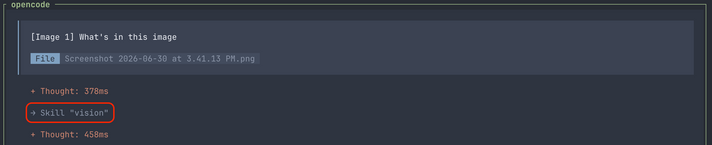
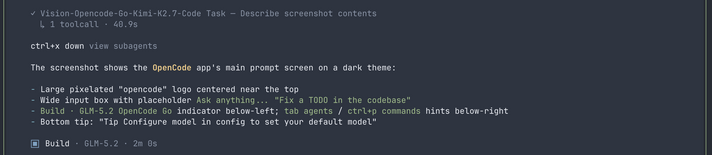
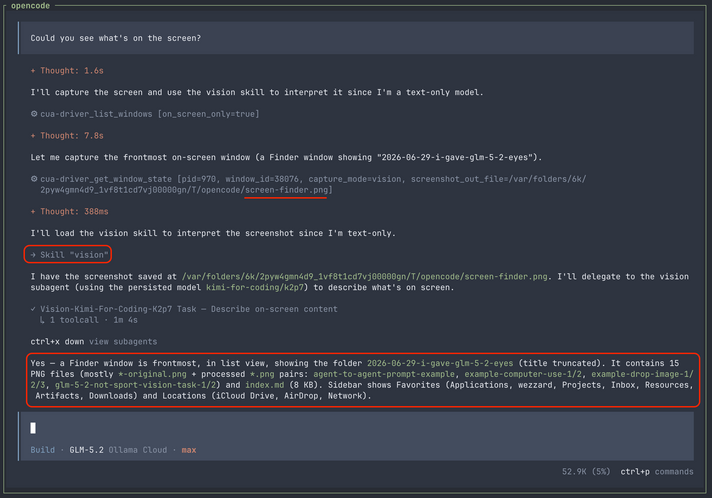
Image as Tool Results:
The same flow applies to screenshots from browser-use and computer-use tools (chrome-devtools, Playwright, cua-driver, and similar).
2. Picking the Vision Model
On the first visual task, the orchestrator runs the bundled model discovery script and presents a short list of image-capable models from your configured providers. Pick one — that selection is persisted for future sessions.
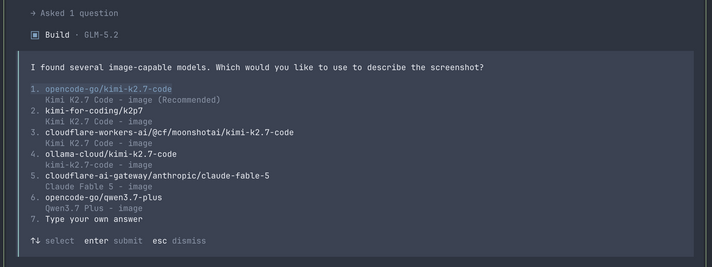
Your choice is saved to ~/.config/opencode/vision-model-image.txt and reused in later sessions. A vision subagent inspects the image and returns structured findings as text for the main agent to relay.
3. Re-picking the Vision Model
Re-picking the vision model is very simple: just say, "Select the vision model."
4. Temporarily Bypassing the Plugin
When your main model is already vision-capable (for example GPT with native image input), native multimodality is usually the better path. Plugins installed with opencode plugin do not appear in OpenCode's plugin management UI, so bypass the skill per task by prepending this to your prompt:
You MUST not use the vision skill.
OpenCode will skip the vision skill for that task.
License
MIT — see LICENSE.
Learn more about the design in I Gave GLM-5.2 Eyes.