
opencode-bb-specBB-Spec 开发纪律与 spec→plan→exec→review 工作流的 opencode 插件:26 个 skills、10 个编排 subagent、11 个 command、4 个流程守卫 hook。
5
983
88 in 7 days
44.4
Multi-signal model
13 days ago
2026-08-07
Install and configure
opencode.jsonWrites to this project's opencode.json — applies to this repository only.
opencode.json
{
  "$schema": "https://opencode.ai/config.json",
  "plugin": ["opencode-bb-spec@12.1.0"]
}
Writes to ~/.config/opencode/opencode.json — applies to every project.
~/.config/opencode/opencode.json
{
  "$schema": "https://opencode.ai/config.json",
  "plugin": ["opencode-bb-spec@12.1.0"]
}
If you want to modify the plugin locally, install it into the project and reference the local path.
shell
pnpm add -D opencode-bb-specopencode loads npm dependencies through its embedded runtime on startup and caches them locally — no manual global install needed.
📐 BB-Spec
A spec-driven Claude Code pipeline that carries fuzzy requirements all the way to shipped code.
Every stage traceable, resumable, and adversarially verified — with companion stack-constraint suites for Go / Vue + bun / TDD / git discipline.
Runs on both Claude Code and opencode — jump straight to the install guide for your host.




English · 简体中文 · 繁體中文 · 日本語 · 한국어
Quick Start · Pipeline · Stages · Skills · Install · Hooks · Acknowledgements
🚀 30-second start
/plugin marketplace add 0xBB2B/bb-spec
/plugin install bb-spec-core@0xbb2b
/plugin install bb-spec-workflow@0xbb2b
The 5 mainline commands:
| Command | What it does | When |
|---|---|---|
/spec |
Break a requirement into one-rule-per-file specs | New requirement |
/plan |
spec → function-level implementation plan | Spec is ready |
/exec |
Three-agent isolated Test→Impl→Review | Plan is ready |
/review |
Parallel finders + adversarial verify | Before opening PR |
/git-push |
pre-review self-check + push + open PR | Ready to ship |
Three branches, callable anytime: /git-clone (pull a remote project locally + write .bb-spec.yaml, one-shot onboarding), /revise (route any deviation back to the right stage by root cause), /doc-update (whole-repo spec / doc / code consistency sweep).
Optional upstream: /prd (PM / requester brainstorms a PRD; shipped separately as bb-spec-product).
🔁 The spec → ship pipeline
 (opt) /git-clone ──► clone remote + write .bb-spec.yaml
   │
 (opt) /prd ──► PRD doc
   │
 /spec ──► /plan ──► /exec ──► /review ──► /git-push
  what       how      Red→Green→Review  finders+adv  pre-review+open PR
                                                          │
        ┌─────────────────────────────────────────────────┘
        │
        ▼ /revise (anytime, routed by root cause)
          spec-defect → /spec   ·   impl-drift → /exec   ·   review finding → targeted fix

 (opt) /test-webview · /test-api — frontend / backend e2e between /exec and /review
 /doc-update (periodic / on-demand) — sweep whole repo → default updates spec/doc;
                                        obviously bad code stops to ask → routes to /revise
Why this pipeline is reliable — every handoff is a file on disk, not a memory in the chat. That's what makes it resumable, AI-swappable, and auditable end to end.
🎯 Stages at a glance
/git-clone— One-shot onboarding: pull a remote repo locally and write.bb-spec.yaml.- Two AskUserQuestion prompts: ① single-repo vs multi-repo workspace (decides directory layout) ②
base_dir(decides where every later bb-spec artifact lands) - Multi-repo workspace: creates a shared parent dir and clones each member repo into it (restoring the relative layout the build tool expects); refuses to nest or overwrite
- Tightly scoped: only pulls code + writes
base_dir— does not read code or install deps
- Two AskUserQuestion prompts: ① single-repo vs multi-repo workspace (decides directory layout) ②
/spec— Requirement breakdown through dialogue. Answers "what to build."- One rule per file, ≤100 lines, one thing + one example, non-overlapping
- Lightweight
INDEX.mdup front — readers scan the index before loading specifics
/plan— spec → self-contained, function-level plan. Answers "how to build it."- One independent problem per file, down to function names and responsibilities; declarative artifacts (DDL / API contracts / config) are inlined in final form for exec to write verbatim
- Invocation enters plan mode for read-only alignment — nothing lands until you approve; new third-party dependencies are listed as a dedicated section, and approval counts as the explicit user consent version-policy requires
/exec— Three-agent isolated execution, the core anti-cheat design.- Test agent reads spec rules only, writes failing tests (Red)
- Impl agent never sees the spec, only the tests + function list, so it can't quietly "teach to intent"; new third-party libs capped by the plan's approved list
- Review agent checks against the spec, read-only
- Progress written to
PROGRESS.mdafter every step — token-exhausted runs resume losslessly
/test-webview— Web-interaction acceptance for frontend / web projects.- Brings the app up via the project's Docker stack (confirmed once, then remembered;
down -vcleans up afterward), drives a real browser via the browser MCP - Each case runs in an isolated serial subagent — hundreds of cases never blow the main context; fully serial (shared single browser)
- Cases auto-generated from spec / plan / PRD; coverage alignment before a full run, gaps never silently dropped; failures route to
/revise - Requires a browser MCP (playwright / chrome-devtools)
- Brings the app up via the project's Docker stack (confirmed once, then remembered;
/test-api— API e2e for any backend.compose.e2e.yamlbrings the stack up; md cases mechanically render to a single-file Bun TS runner that runs in one shot viabun run- Zero subagents, zero concurrency — HTTP is deterministic, clock state is shared
- Time-sensitive rules (token expiry, order timeout, points expiry) tested through
/test/advance-time,/test/backdate,/test/trigger-job - App side ships two images: test image carries
/test/*routes +ENV TESTAPI=1; production image physically excludes/test/*source;/test/healthzprobe gates the run, no fallback
/review— Workflow-orchestrated, adversarially verified local PR review.- Phase 1 fans out 6 finders in parallel: code quality / security / simplicity / robustness / doc-sync / Codex cross-model independent review, schema-enforced
- Phase 2 every 🔴/🟡 re-judged by 3 independent skeptic lenses (importance / root-cause / risk-if-unfixed), majority vote
- Read-only — never auto-edits; requires Claude Code ≥ 2.1.154
/revise— The exception handler, callable anytime.- Classifies a deviation's root cause into one of three: spec-defect (→
/spec), impl-drift (→/exec), requirement-change - Every review finding that needs fixing funnels through here
- Classifies a deviation's root cause into one of three: spec-defect (→
/git-push— User-triggered push + PR flow (single or multi-repo).- When a spec
INDEX.mdexists, first runs a branch-spec self-check (pre-review): a subagent diffs the branch vs main against the spec, fixes violations in a loop - Drafts a 6-section PR description (background / requirement / approach / result / tests / spec, < 50 lines) used directly as the PR body
- When a spec
/doc-update— Whole-repo spec / doc / code consistency sweep.- Six drift classes: spec-stale / doc-stale / code-violation / spec-conflict / orphan-index / uncovered-rule
- Code is the truth; spec / docs are mirrored to it; only obvious hard-constraint violations stop and ask, then route to
/revisefor TDD - Clear boundaries against
/revise(single point) and the/reviewreview-doc-syncfinder (PR-diff scope)
Ships with
- 11 orchestration subagents driven by the stages above:
test-engineer/impl-engineer/spec-reviewer/webview-test-runner/review-code-quality/review-security/review-simplicity/review-robustness/review-doc-sync/review-codex/pre-reviewer - 4 passive hooks (automatic): block npm/yarn, block main commit, dependency version self-check, Stop four-point self-check
🧩 Companion constraint skills
These feed rules into the pipeline above — install only the layers you need.
bb-spec-product — product requirements (pipeline upstream)
prd— PM / requester brainstorms with AI: challenge first (rejection is a valid outcome) → diverge → converge, producing a self-contained PRD — goals / non-goals, prioritized user stories (every P0 carries concrete use cases and acceptance criteria), and open questions left for engineers; needs no git repo or code context, consumed directly by/spec
PMs don't need Claude Code: every release auto-packages
bb-spec-prd-skill.zip— download it and upload via Settings → Customize → Skills on claude.ai web / desktop to use the skill standalone (paid plan with code execution required); the resulting PRD is delivered to engineers as a downloadable file.
bb-spec-core — universal discipline
tdd-workflow— Red-Green-Refactor discipline with standard flows for the add / modify / delete scenariosversion-policy— Standard/official libraries first — importing a new third-party library requires explicit user consent (a plan-approved dependency list counts); check a dependency's official latest version before pinning it; never trust training memorygit-workflow— Branch decisions, incremental commits, the six-section PR description, post-merge cleanup
bb-spec-backend — backend stack constraints
golang-constraints— Whole-lifecycle Go: three-layer architecture, no over-abstraction, tests subordinate to production designgolang-testing— Go test organization: table-driven, subtests, benchmark, fuzzapi-design— REST design: resource naming, status codes, pagination, and structuredA-BBB-CCCCerror codesdatabase-constraints— App-generated UUIDv7 PKs, soft delete + composite UNIQUE, DB-managed timestamps, UTC end to endauth-constraints— Authentication (authN): dual-token JWT + opaque refresh with rotation & replay detection, sliding expiry, argon2idauthz-constraints— Authorization (authZ): deny-by-default, centralized decision, two-tier role + resource-ownership checks to stop IDORobservability-constraints— Logs / traces / metrics on OTel: one-time assembly, structured JSON with stable trace_id, bounded label cardinalityservice-constraints— Runtime governance: env-injected secrets with fail-fast, graceful lifecycle, write idempotency, timeouts + safe retriesconfig-constraints— Config carrier tiers: env/secret for startup-critical non-hot-reload, yaml/configmap for hot-reloadable defaults, DB for dynamic business config; core credentials in secret/KMS only, envelope encryption when pushed down to DB
bb-spec-frontend — frontend stack constraints
vue-constraints— Vue 3 + TypeScript + Vite + Tailwind + bun hard stack constraintsfrontend-constraints— Conventions: one unified request client, centralized error-code → UI mapping, UX-only route guards, types from the contract
🧭 Platforms / Claude Code vs opencode
Both hosts ship the same content — 26 skills, orchestration subagents (11 on Claude Code, 10 on opencode), and 4 workflow-guard hooks (behavior-equivalent) — released in lockstep on a single version line. The differences are only in distribution and host mechanics; pick the one matching your environment (installation in the two sections below):
| Dimension | Claude Code | opencode |
|---|---|---|
| Distribution & install | 5 sub-plugins via marketplace — install only the layers you need | one npm package opencode-bb-spec, declared once in opencode.json |
| Command entry | all 26 skills invocable as /name slash commands, plus context auto-trigger |
11 pipeline commands (/spec /exec /review …); remaining skills auto-loaded by the model on demand |
| Cross-model review | review-codex dispatched through the codex plugin | Not provided — opencode can natively run GPT-family models |
| Updates | /plugin update |
bump the npm package version |
📦 Claude Code Install
BB-Spec ships as five independently installable sub-plugins — install only the constraint layers you need.
First add the marketplace once, inside Claude Code:
/plugin marketplace add 0xBB2B/bb-spec
Then install whichever layers you want:
| Sub-plugin | What it gives you | Command |
|---|---|---|
| bb-spec-core (recommended base) | TDD / version-policy / git-workflow discipline + 3 passive hooks | /plugin install bb-spec-core@0xbb2b |
| bb-spec-workflow (core) | spec → plan → exec → review → revise → git-push (+ opt test-webview / test-api e2e), git-clone one-shot init, init reverse-spec, doc-update whole-repo consistency sweep + 11 subagents | /plugin install bb-spec-workflow@0xbb2b |
| bb-spec-product | /prd requirement brainstorm → PRD doc with concrete use cases (for PMs / requesters) | /plugin install bb-spec-product@0xbb2b |
| bb-spec-backend | Go / REST API / DB / authN / authZ / observability / service / config constraints | /plugin install bb-spec-backend@0xbb2b |
| bb-spec-frontend | Vue 3 + TS + Vite + Tailwind + bun stack & engineering conventions (+ bun hook) | /plugin install bb-spec-frontend@0xbb2b |
Pick by need — e.g. just the disciplines and workflow without any stack opinions: install bb-spec-core + bb-spec-workflow. On a PM's / requester's machine: just bb-spec-product. Want everything: install all five.
Or add it manually to ~/.claude/settings.json (enable only what you want):
{
  "extraKnownMarketplaces": {
    "0xbb2b": {
      "source": { "source": "github", "repo": "0xBB2B/bb-spec" }
    }
  },
  "enabledPlugins": {
    "bb-spec-core@0xbb2b": true,
    "bb-spec-workflow@0xbb2b": true,
    "bb-spec-product@0xbb2b": false,
    "bb-spec-backend@0xbb2b": false,
    "bb-spec-frontend@0xbb2b": false
  }
}
Install via Claude Code Desktop (with screenshots)
For the Claude Code Desktop app (Mac / Windows). Pure GUI flow — no commands required.
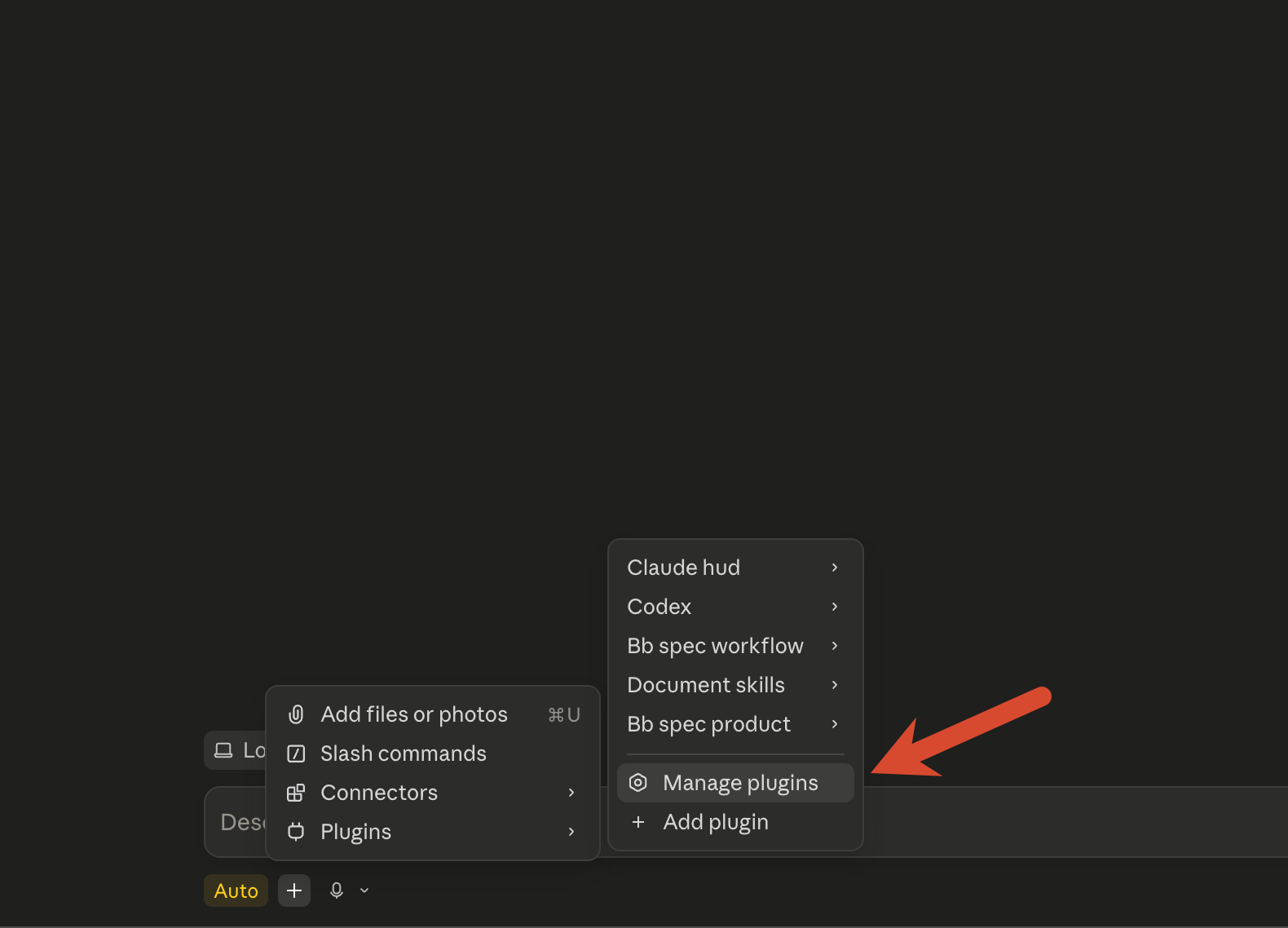
1. Open the plugin manager
Click + in the input box → Plugins → Manage plugins:
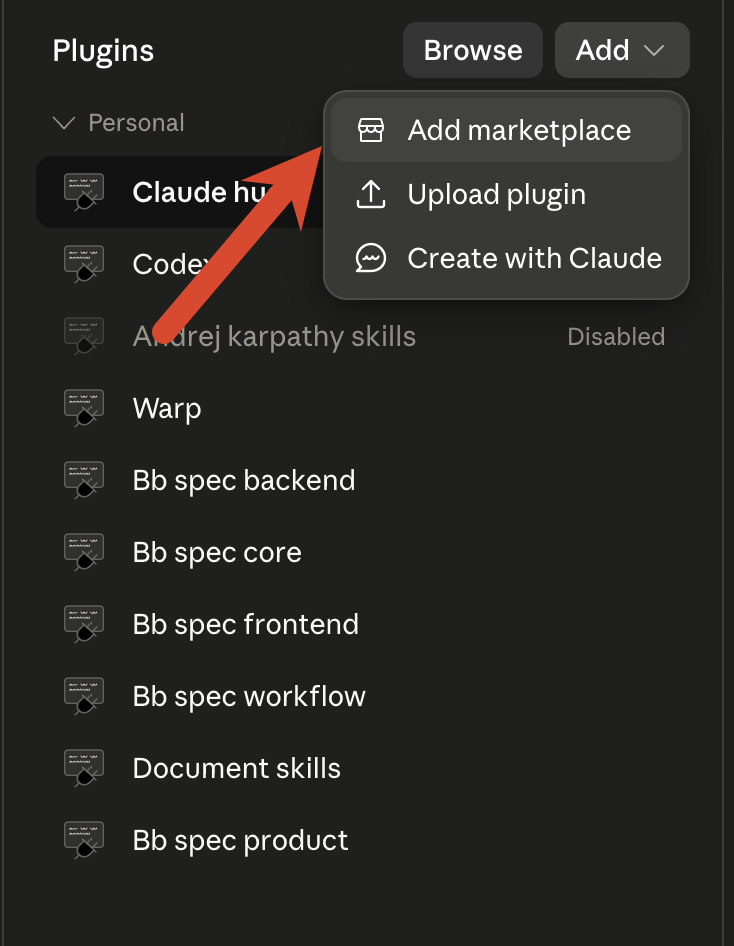
2. Add a marketplace
In the Plugins panel, click Add (top right) → Add marketplace:
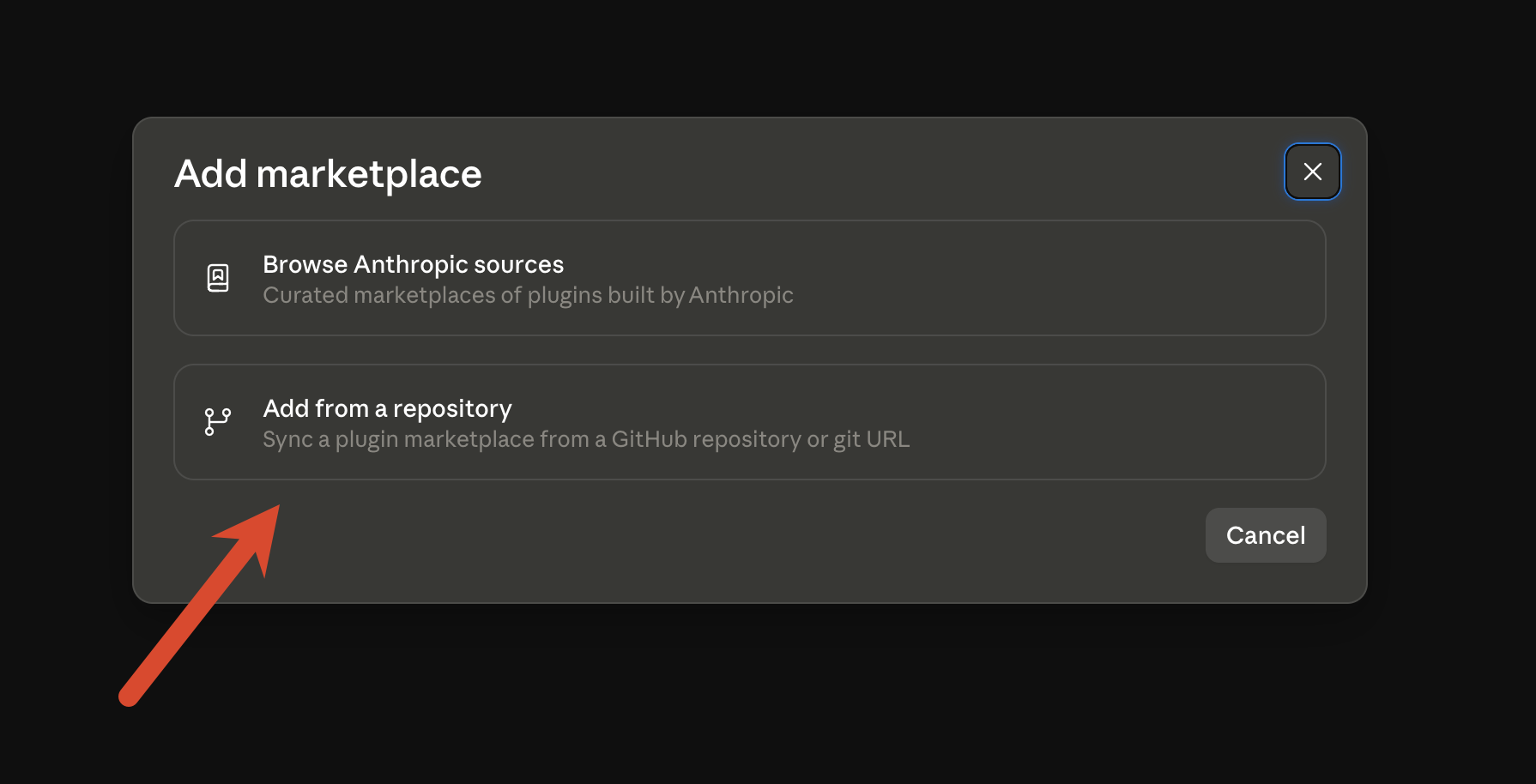
3. Choose "Add from a repository"
In the dialog, pick Add from a repository:
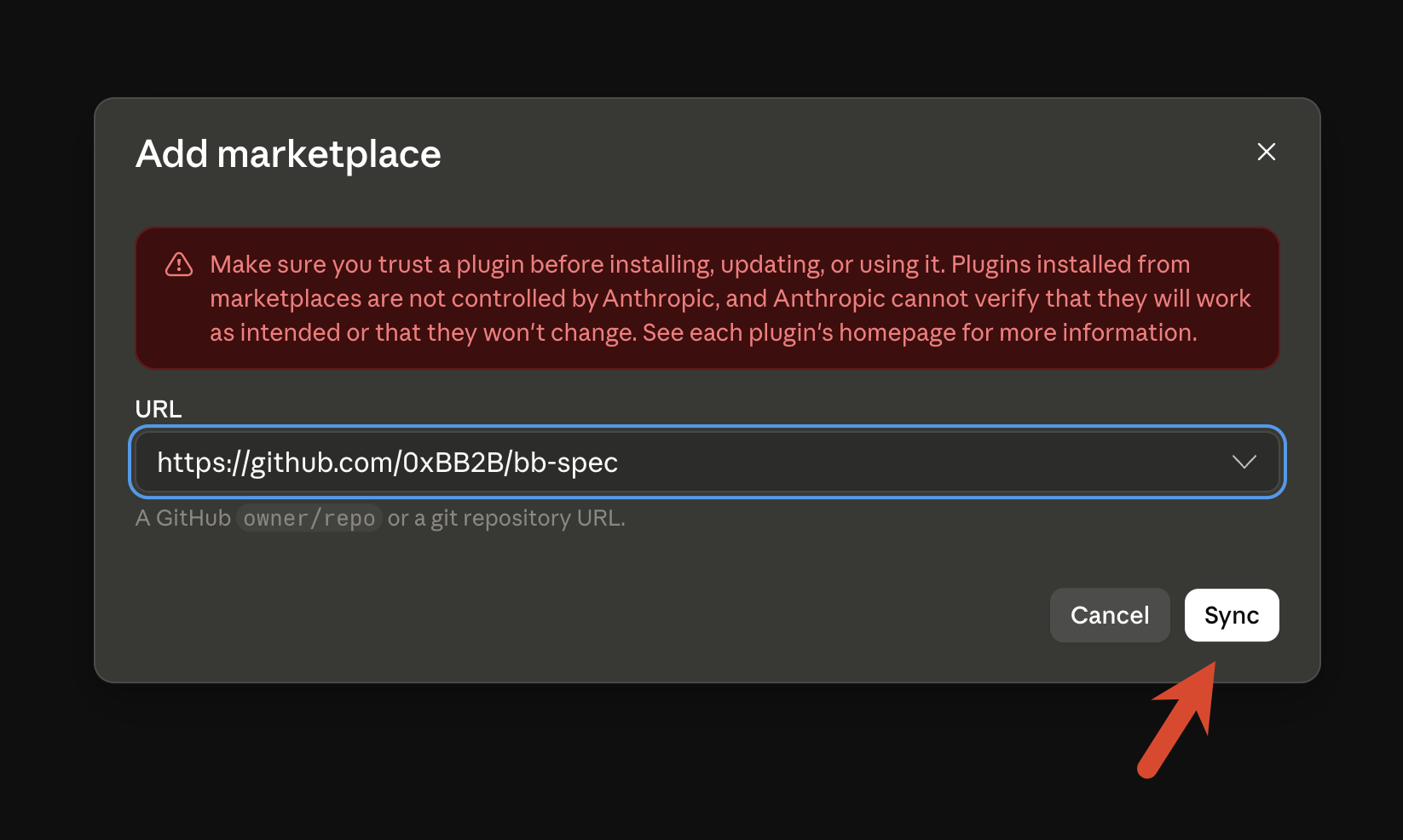
4. Paste the bb-spec URL and sync
URL: https://github.com/0xBB2B/bb-spec, then click Sync:
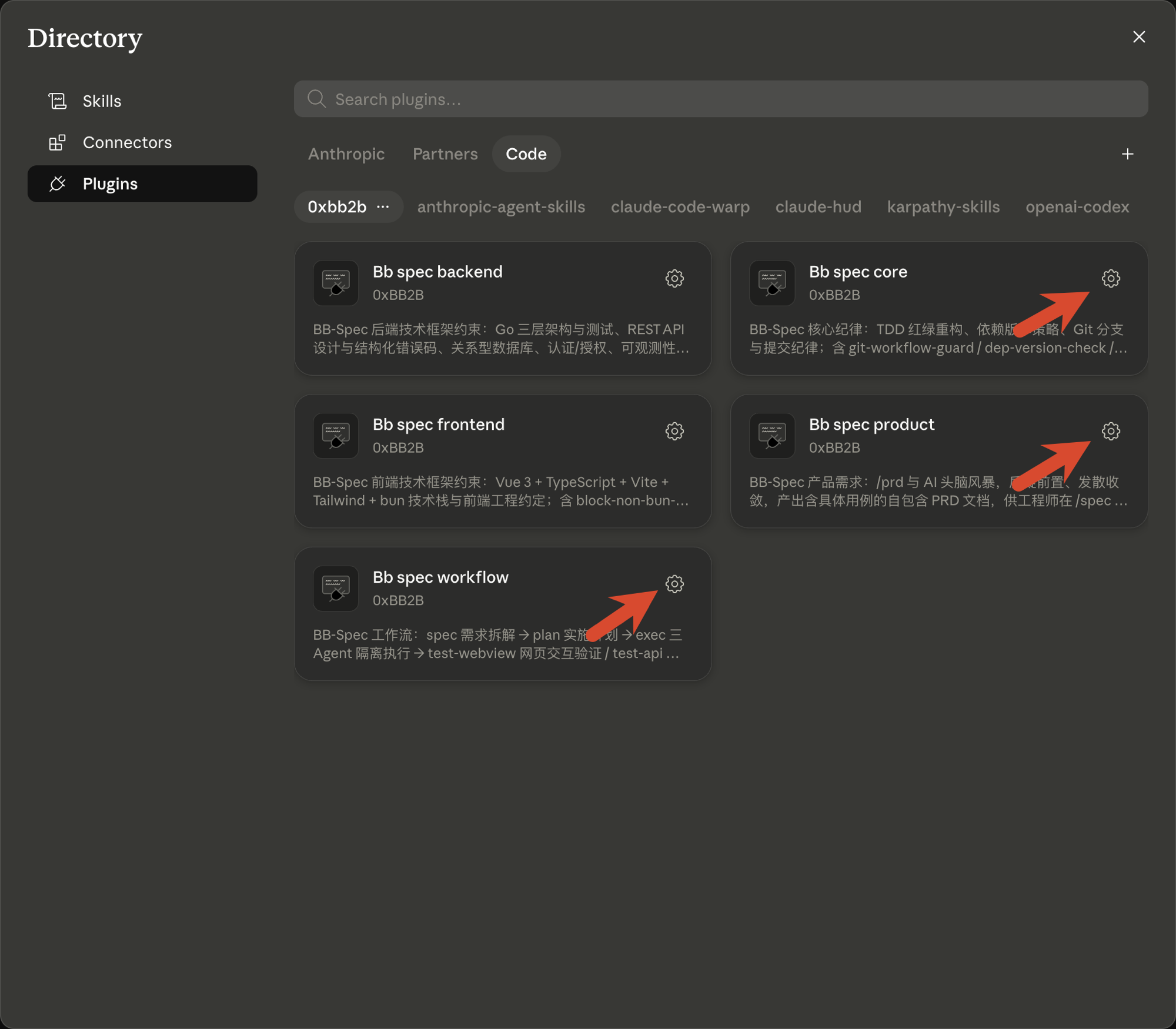
5. Enable the core trio
The Directory now shows bb-spec's 5 sub-plugins. Click the gear icon on the Bb spec core / Bb spec workflow / Bb spec product cards to enable them (backend / frontend optional):
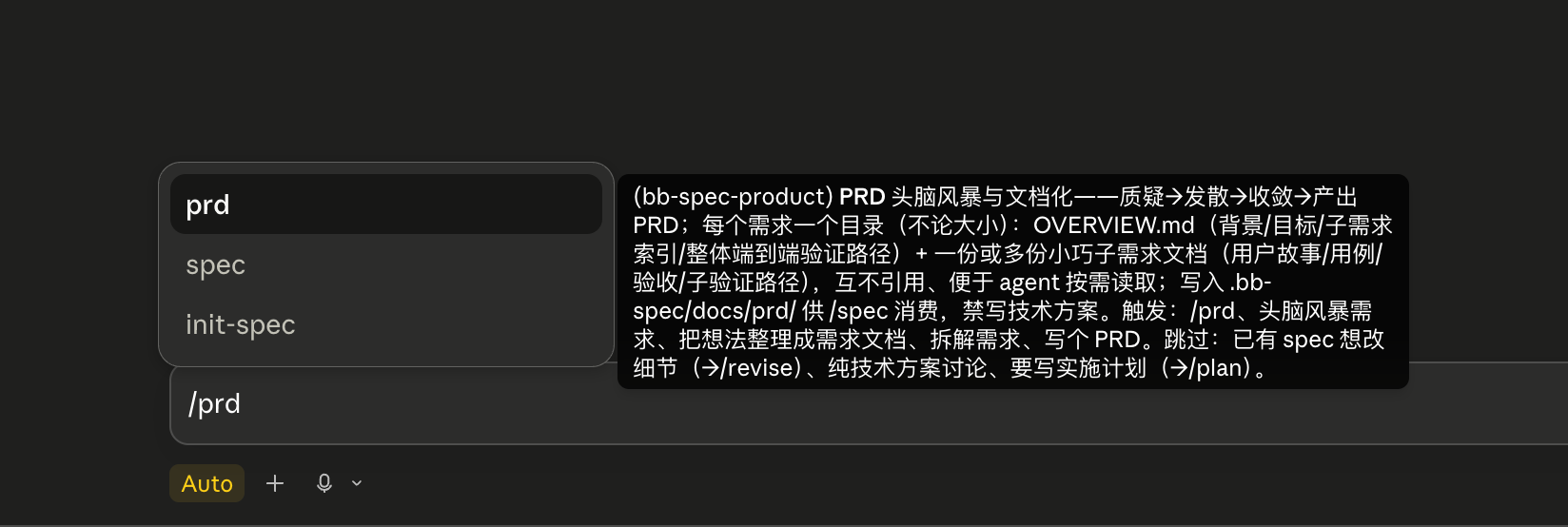
6. Verify the install
Back in the input box, type /prd. If the command suggestion shows up, you're set:
🔌 opencode Install
BB-Spec also ships as an opencode plugin: one npm package delivering all 26 skills, 10 subagents, 11 commands and 4 workflow-guard hooks (full parity except the Claude Code-specific codex cross-model review — opencode can natively run GPT-family models, so no codex CLI detour is needed).
Declare it in ~/.config/opencode/opencode.json (global) or a project-level opencode.json:
{
  "$schema": "https://opencode.ai/config.json",
  "plugin": ["opencode-bb-spec"]
}
Restart opencode, then verify with opencode debug skill. Details and the Claude Code ↔ opencode mapping: opencode/README.md.
🔄 Versioning
/plugin update                  # check and update every installed plugin
/plugin update bb-spec-core     # update only one sub-plugin
The five sub-plugins share a single synchronized version line.
🪝 Hooks enabled by default
Each hook ships with the sub-plugin that owns its concern — install that plugin to get it.
| Hook | Sub-plugin | Trigger | Effect |
|---|---|---|---|
block-non-bun-pm |
bb-spec-frontend | PreToolUse(Bash) | Blocks npm / yarn / pnpm package-manager actions, enforcing bun; existing projects with a matching lockfile (e.g. package-lock.json) are allowed through |
git-workflow-guard |
bb-spec-core | PreToolUse(Bash) | Blocks git commit on main / master; for other git flow actions (branch / push / worktree / merge / PR) allows them through and injects the git-workflow discipline plus live git status |
dep-version-check |
bb-spec-core | PostToolUse(Write|Edit) | After editing a dependency file, injects a "check the official latest version first" reminder |
🧪 Tests
bash tests/validate.sh
Validates the multi-plugin structure: marketplace.json validity and plugin-entry consistency (every source resolves to a real plugin dir whose name matches), each sub-plugin's plugin.json fields, agent frontmatter integrity (required fields, name consistency, valid agent-type values, security-baseline section), skill SKILL.md format, hooks.json validity and script existence, and personal-path leak detection.
CI runs automatically on PRs and pushes to main (.github/workflows/ci.yml).
🛠️ Recommended companions
CLAUDE.md template
The repo-root CLAUDE.template.md is a companion "iron-rule index" reference. It is not installed automatically — copy it to your ~/.claude/CLAUDE.md or a project-root CLAUDE.md as needed and trim to taste.
.bb-spec.yaml project config
/prd, /spec and /plan output under .bb-spec/docs/ by default (.bb-spec/docs/prd/, …/spec/, …/plan/); runtime transient artifacts (e.g. webview screenshots) go to the sibling .bb-spec/.cache/ (auto-gitignored). Create a .bb-spec.yaml in the project root to override the bb-spec root directory:
base_dir: my/bb # → my/bb/docs/{prd,spec,plan,test}/ and my/bb/.cache/ ; use ./ to place them at the project root
Reference template: .bb-spec.template.yaml.
⚙️ Hook switch cheat sheet
| Scenario | Switch |
|---|---|
| Temporarily allow npm / yarn / pnpm | Disable bb-spec-frontend temporarily |
| Temporarily allow main commit | Disable bb-spec-core temporarily |
| Skip the Stop self-check | No switch — this is a core iron rule, skipping is discouraged |
💡 Prior art & acknowledgements
BB-Spec stands on three excellent projects. Each shaped a different part of its design — credited below, alongside what BB-Spec borrowed and how it pushed the idea further.
| Project | What it does best | What BB-Spec borrowed & hardened |
|---|---|---|
| Superpowers (obra) — a complete coding-agent methodology | End-to-end staged workflow, subagent-driven development with phased review, TDD Red-Green-Refactor, git-worktree isolation, Socratic brainstorming, a composable skill library | The whole spec → ship pipeline backbone, splitting work across role-specialized subagents, mandatory TDD, multi-stage / adversarial review, and dialogue-first requirement clarification |
| ECC (affaan-m) — an agent-harness "operating system" | A large layered system of agents / skills / hooks / rules, passive hooks that auto-enforce, rules-as-infrastructure, memory persistence across sessions | The layered, independently-installable sub-plugin suite, passive hooks that enforce discipline, and distilling engineering conventions into loadable constraint skills |
| skills (mattpocock) — "Skills For Real Engineers" | Targets real failure modes (misalignment / verbosity / quality / architecture), deep questioning to align on intent, shared domain language, user- vs model-invoked skills, vertical slicing | Challenge-first dialogue to pin down requirements before any code, dual-trigger skills (slash command + model auto-trigger), and the one-rule-per-file minimalism |
Where BB-Spec goes its own way — differentiators none of the three combine:
- Three-agent isolated execution — the Impl agent physically never sees the spec, only the tests, so it cannot quietly "teach to intent"; tests, implementation, and review are written by mutually-blind agents.
- Disk documents as the only handoff — every stage hands off a file, not chat memory, so a run resumes losslessly across sessions,
/clear, or even a different model picking up the work. - Bidirectional spec ⇄ code loop — not just spec → code:
/doc-updatesweeps the whole repo and updates specs as the code drifts.
📜 License
MIT — see LICENSE.
Built with ❤️ for the Claude Code community.